
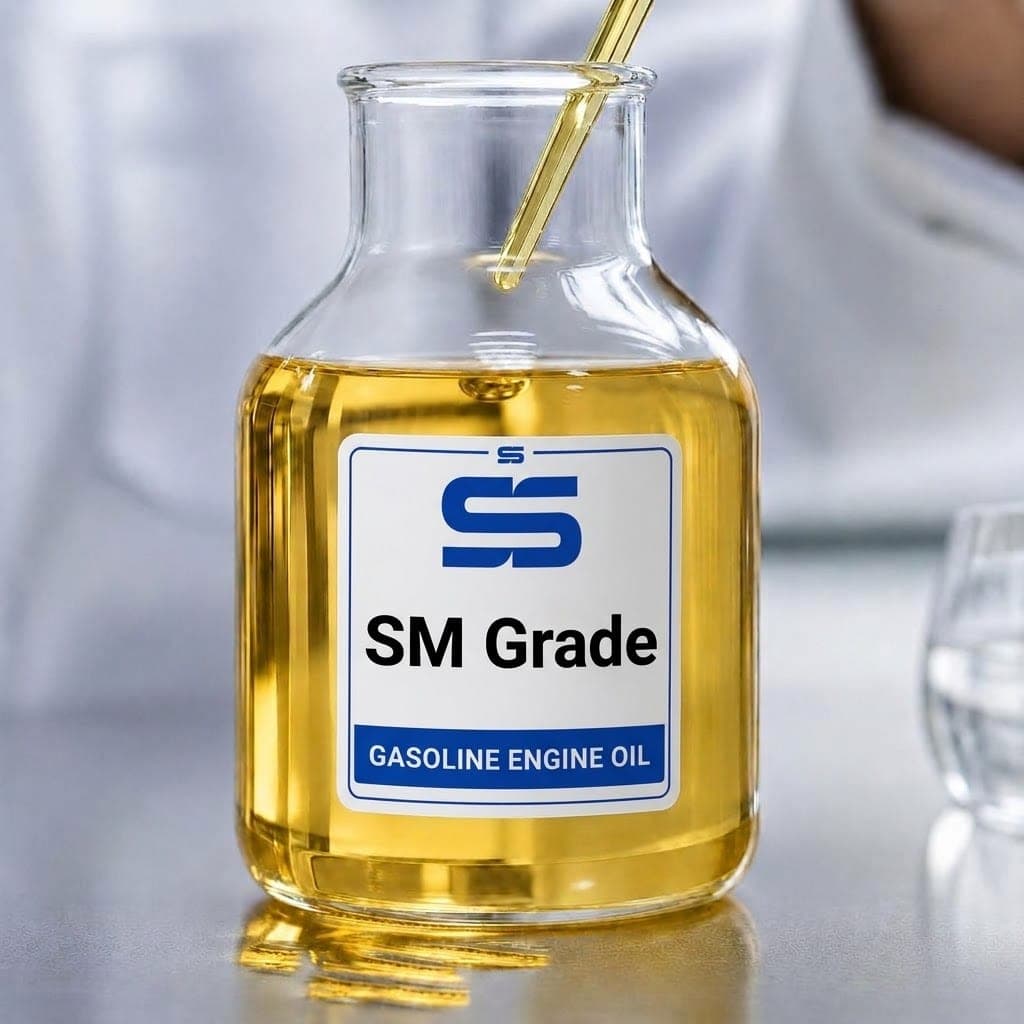
SM Grade

SM Grade is a multigrade gasoline engine oil blended from synthetic base oil and additives for modern gasoline cars; its grades carry a dual API SM/CF designation. Available grades: SM/CF 5W40, SM/CF 10W40. API lists SM as a current category for gasoline automotive engines of model year 2010 and older.

Some details are shown in the site’s default language because this product has not been translated yet.

  • Kinematic viscosity at 100 °C15cStASTM D-445
  • Viscosity index165ASTM D-2270
  • Total base number (TBN)7.5mg KOH/gASTM D-2896
  • Pour point-39°CASTM D-97

Grades & published data

All grades side by side

Typical values from the product data sheet, each with its test method.

PropertySM/CF 10W40SM/CF 5W40Method
Kinematic viscosity at 100 °CcSt1515ASTM D-445
Viscosity index150165ASTM D-2270
Total base number (TBN)mg KOH/g7.57.5ASTM D-2896
Pour point°C-33-39ASTM D-97
Flash point (open cup)°C210210ASTM D-92
Density at 15 °Ckg/m³870860ASTM D-4052

Overview

SM Grade is a multigrade gasoline engine oil blended from synthetic base oil and additives for modern gasoline cars; its grades carry a dual API SM/CF designation. Available grades: SM/CF 5W40, SM/CF 10W40. API lists SM as a current category for gasoline automotive engines of model year 2010 and older.

Each grade is listed separately in the specification table with its viscosity at 100 °C, viscosity index, flash point, pour point, density and base number, so grades can be compared directly before ordering.

Application

Gasoline passenger cars

Vehicles whose handbook calls for API SM — per API, gasoline engines of model year 2010 and older.

Feature

Published values by grade

SM/CF 5W40: KV100 15 cSt, VI 165, TBN 7.5, pour point -39 °C; SM/CF 10W40: KV100 15 cSt, VI 150, TBN 7.5, pour point -33 °C.

Feature

Choice of viscosity grades

2 grades in one product line, so a fleet can standardise on one API level across different climates or engine requirements.

Questions

Which grade should I choose?

Follow the SAE grade in your vehicle handbook. Under SAE J300 a lower W number is rated for colder starts (0W at −35 °C, 5W at −30 °C, 10W at −25 °C, 20W at −15 °C); the second number is the viscosity class at operating temperature.

Documents & supply

  • TDSTechnical Data SheetProperties, test methods and guidanceRequest
  • SDSSafety Data SheetHazards, handling, storage and transportRequest
  • COACertificate of AnalysisIssued per batch, with its test resultsRequest
  • Bulk
  • Flexitank
  • Drums
  • IBC
  • Pails & retail packs
  • EXW · FOB · CFR · CIF
Export & Logistics

Next step

Can't find exactly what you need?

The range above is what we publish. Formulation to a customer brief is a route of its own, and a sample is the first stage of it.

Request a custom solution