
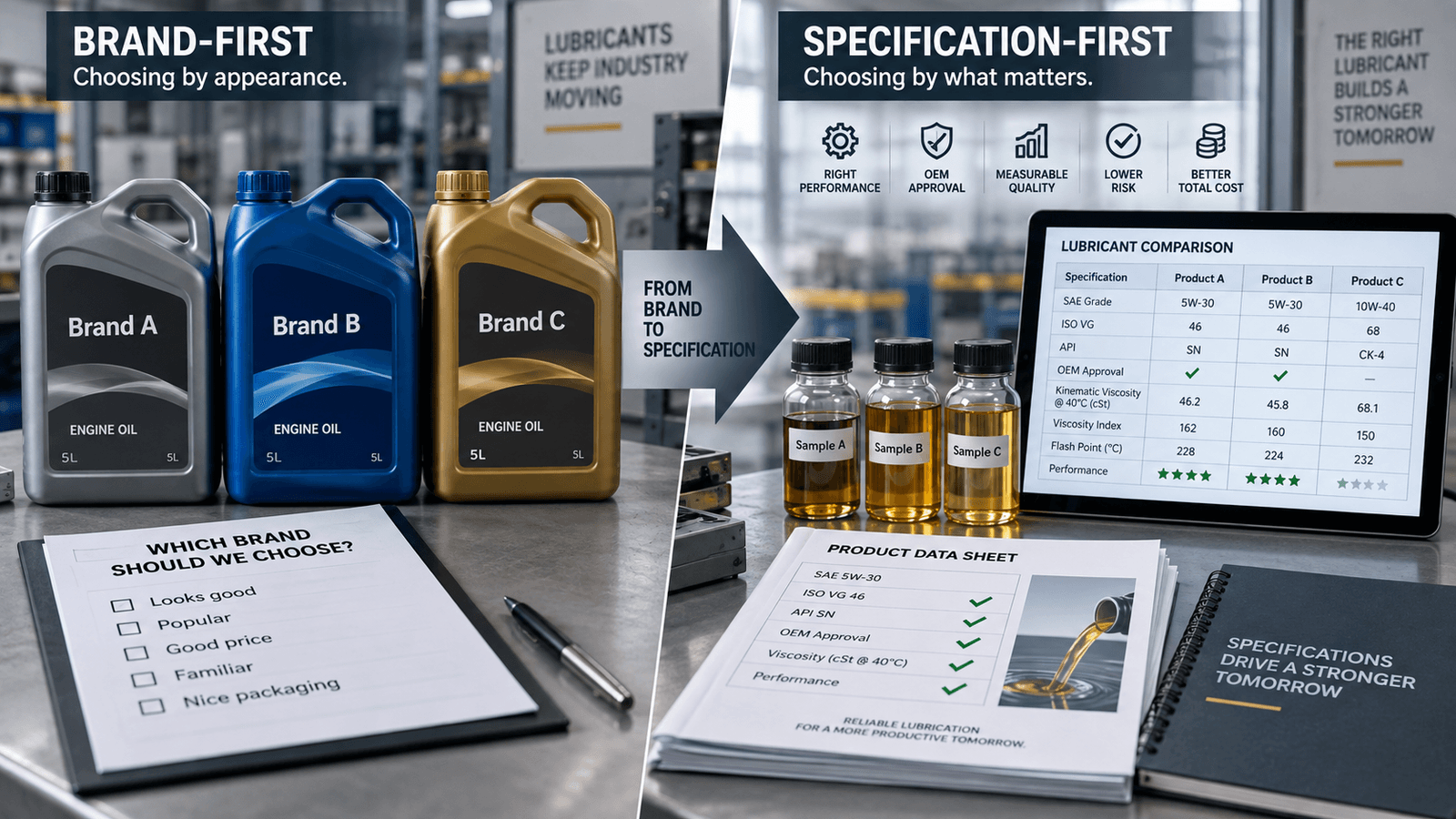
For decades, buying a lubricant meant buying a brand. A purchasing team would ask for "the 15W-40 from our usual supplier" and trust that the label carried the performance the equipment needed. That habit is fading in industrial and automotive lubricant procurement, and the shift is worth understanding before it becomes the default expectation of every buyer.
WHAT IS ACTUALLY CHANGING
Buyers increasingly open a purchase with a specification, not a brand: an API service category, an SAE viscosity grade, an ISO VG number, or an OEM approval, stated before any supplier name enters the conversation. The question moves from "which brand do you carry" to "can you document this grade against this standard, for this batch." A base-oil group, an additive treat rate, a flash point, a pour point — these become the actual purchasing criteria, and the brand becomes secondary to whether the documentation answers the question.
WHY IT IS HAPPENING NOW
Three pressures are pushing procurement in this direction at the same time. Equipment manufacturers keep tightening the specifications engines and machinery are built against, so a grade that satisfied an older approval may not satisfy the current one. Maintenance and reliability teams are held accountable for equipment life, which pushes them to ask for the test method behind a number rather than accept the number on its own. And cross-border buyers, sourcing from suppliers they may never inspect in person, lean on the technical document — the TDS, the SDS, the certificate of analysis — as the thing that actually travels with the shipment, because a brand name does not answer a customs question or a warranty claim.
WHAT IT MEANS FOR SOURCING
A specification-first buyer needs a supplier that can operate the same way: state the grade, back it with a test method, and produce the document at the batch level, not only at the product-line level. That is a different relationship than picking a can off a shelf. It means the enquiry starts with the equipment, the duty and the required standard, and the quotation that comes back names a grade and a document before it names a price.
WHERE THIS LEAVES A PRODUCER
This is the reason SAM Group is built around production, not resale. Working from the base-oil group and grade up, through additive selection, to the finished product means the same operation that blends the batch is the one that can answer a specification question about it — incoming review, in-process control and outgoing testing are stages of one process, not a claim made about someone else's product. For a buyer who has already made the shift to specification-first purchasing, that is what a supplier conversation needs to start with.
Explore the product range by family and grade on the Products pages, or send the required specification directly through a quotation request.